Friday, 24 December 2021

Table Talk with Anita Roy, Kishi Arora, Krish Ashok, Kriti Monga, Kurush Dalal, Ranjini Rao, Rushina Munshaw-Ghildiyal, Saba Mahjoor

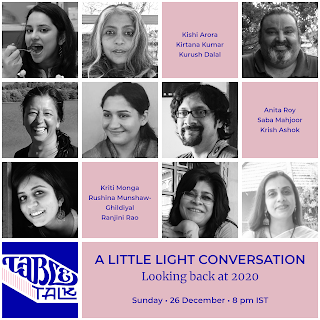
The flyer has portraits of Anita Roy, Kishi Arora, Krish Ashok, Kriti Monga, Kurush Dalal, Ranjini Rao, Rushina Munshaw-Ghildiyal, Saba Mahjoor, the logo Table Talk, and the text: Headline: ‘A little light conversation’ Subhead: ‘Looking back at 2021’ Below, ‘Sunday, 12 December, 8 p.m. IST’

Table Talk with with Anita Roy, Kishi Arora, Krish Ashok, Kriti Monga, Kurush Dalal, Ranjini Rao, Rushina Munshaw-Ghildiyal, Saba Mahjoor
Date: December 26, 2021
Time: 20:00 IST

Table Talk brings the year to an end with an informal chat with as many of our 2020 guests as could make it.

We’ll be looking back at the year and what we have learnt from it, with reference to food, but, as we have found through these past conversations, that can intersect with just about anything.

And of course we look forward to all of you joining us too.

We’ll chat for two to three hours, maybe more if you and our guests are willing.

Attending

You will need to go to the Zoom link and register with a valid email address, after which you will get the link to join the event.

To get notifications of new episodes and links to past episodes, please subscribe to:
- this Google Group: https://groups.google.com/d/forum/ttandfps
- and / or this Telegram Channel: https://t.me/TTandFPS

(About Table Talk and past guests)

Friday, 10 December 2021

Check this

What connects Chennai, Scottish Lace, Brooks Brothers, David Ogilvy, and a pioneering Indian luxury hotel chain?

In the 1950s, CP Krishnan Nair, who had quit the army, helped start the All India Handloom Board. He was also an entrepreneur, one who started multiple companies, many named after his wife. At one point, he sold a shipment of madras fabric (worth a look-up on its own, if you’re not familiar with it) to an American buyer, with the warning that the cloth should only be washed gently in cold water or the fabric would bleed. Someone neglected to tell Brooks Brothers, who had bought a sizeable amount of the cloth, about this. And so the clothes they made from the fabric went out to customers without appropriate washing instructions, and the bright dyes bled, and the colours faded.

The importer summoned Nair to the USA, threatened legal action. Instead they worked out a brilliant compromise and turned this lemon into lemonade.

They arranged an interview with Nair with Seventeen magazine. He made up from whole cloth (hehe) a story about this fabric made exclusively for Brooks Brother, and the mag ran a seven-page piece about “Bleeding Madras — the miracle handwoven fabric from India.”

Ogilvy? He turned the defect into a USP: “Guaranteed to bleed,” the ads said. One catalogue in 1966 carried this copy: “Authentic Indian Madras is completely handwoven from yarns dyed with native vegetable colorings. Home-spun by native weavers, no two plaids are exactly the same. When washed with mild soap in warm water, they are guaranteed to bleed and blend together into distinctively muted and subdued colorings.”

And Scottish Lace? Among the many companies Nair started was a lace-making factory in Sahar, Bombay, named Leela Scottish Lace, which was also the company that sold that fabric which landed up with Brooks Brothers.

And if you were around when the Leela Kempinksi (as it was first called) came up, you may have noticed a sign nearby with the company name. Captain Nair, as he was popularly known, is perhaps best remembered for the hotel chain.

(By the by, there is a town in Oregon, USA, called Madras (population 6,000-odd), and one story is that it was named after madras fabric.)

Bonus: there’s a connection with bermuda shorts.

In the 1930s, the Bermuda Athletic Association would invite Ivy League teams to play their rugby a tournament. This became so popular that there were chartered flights for students, who would bring back clothes they bought there. Among them, plaid- and madras-patterned swimwear and shorts, which then made their way to jackets and suchlike with the preppy New England folks.

Sources Gentleman’s Gazette, Orvis, Madras Musings, Wikipedia article on CP Krishnan Nair

Thursday, 9 December 2021

Table Talk with Manu Chandra

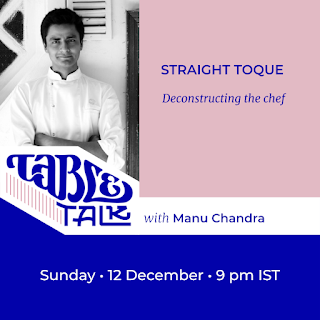
The flyer has a portrait of Manu Chandra over the logo Table Talk, which flows into their name. The text: Headline: ‘Straight toque’ Subhead: ‘Deconstructing the chef’ Below, ‘Sunday, 12 December, 9 p.m. IST’

Table Talk with Manu Chandra
Date: December 12, 2021
Time: 21:00 IST

The various Olive brands, Toast & Tonic, Monkey Bar, The Fatty Bao, Cantan… You’d think I would have first encountered Manu through one of the many innovative, popular and critically acclaimed restaurants he has nurtured and/or created. But when he was making his mark, I was going through a particularly insolvent phase and then rebuilding from there, and fine dining was something that was, as my young friends say, out of my aukat. I first met him when I was editing ForbesLife India, and he wrote for us about the importance of sourcing local ingredients, and since then, his has been one of the voices on food that I’ve listened to carefully. At one point I somehow wound up on the guest list for the opening of The Fatty Bao in Bombay, and had the additional good fortune of having Manu sit with Antoine and I and informally explain some of the thinking behind his ideas.

The making of Chef Chandra started with an early interest in food and what went into making it and presenting it, and continued with formal study (like previous guest Kishi, he trained at the Culinary Institute of America, and their times there overlapped a bit), apprenticing in celebrated kitchens (Restaurant Daniel, Le Bernardin, Gramercy Tavern, Café Centro, Jean Georges), formative jobs (Mandarin Oriental,  Eyvind Hellstrom’s Bagatelle), prizes (a Sea Food Masters Award for the National Recipe Competition in the USA), before he returned to India, where he joined Olive Beach in Bangalore as Chef de Cuisine.

We will chat about this journey and his other formative influences, his work highlighting locally sourced ingredients, what it takes to be a chef, the challenges of running restaurants — multiple restaurants, each with distinct identities — the joys and sorrows of celebrity, The Social Kitchen, an initiative he is part of that wants to “bring families back to the kitchen or table to interact and talk using new kitchen design,” and what he’s been up to since he decided, a few months ago, to leap into the unknown. As ever, be prepared for digressions — these are conversations, not formal interviews — and you’re welcome to nudge us into them or back on topic.

We’ll chat for at least a couple of hours, including questions from and discussion with the audience, and may go on longer, if Manu and you are willing.

Giving back

Table Talk will stay free to attend and free to listen to or watch later, for as long as I can afford to keep it that way. But we would like to use our privilege to help others, so we’re asking our guests to choose a cause.

(I’ll add Manu’s choice here shortly.)

Attending

You will need to go to the Zoom link and register with a valid email address, after which you will get the link to join the event.

To get notifications of new episodes and links to past episodes, please subscribe to:
- this Google Group: https://groups.google.com/d/forum/ttandfps
- and / or this Telegram Channel: https://t.me/TTandFPS

(About Table Talk and past guests.)

Wednesday, 8 December 2021

At Poetry with Prakriti this Saturday.


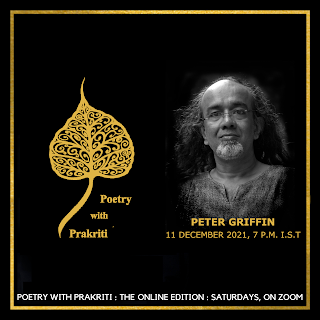
I’m reading at Poetry with Prakriti this weekend. 11th December, 7 p.m. I.S.T.

Please come by if you’re free and not too Zoomed out? Register (free) here.

Tuesday, 23 November 2021

Table Talk with Kishi Arora

The flyer has a portrait of Kishi Arora over the logo Table Talk, which flows into their name. The text: Headline: ‘The sweet spot’ Subhead: ‘Finding the balance’ Below, ‘Sunday, 28 November, 9 p.m. IST’

Table Talk with Kishi Arora
Date: November 28, 2021
Time: 21:00 IST

You would think having a pal who is a pastry chef — qualified from the Culinary Institute of America no less — would be a really useful thing, right? But for over a decade now, Kishi has been sending me photographs of cake for my birthday. Would you think someone with as angelic a face could be so cruel?

Seriously though, I’m a long-time fan of hers. I first met Kishi when she was among a group of TED India Fellows I knew, and as is the way of this world, most of our subsequent friendship has been over social media, with that combination of distance and affection that so many of us know. Kishi’s a highly qualified chef, as I said, who worked in the USA and Singapore before coming back to India, where she has been a consultant for brands like Mad Over Donuts and Nature’s Basket, and Godfrey Philips India. She is also an entrepreneur, with her company Foodaholics which currently has her own line of custom-made desserts and her mother’s home-cooked meals business, Mama K Treats.

We will talk about her culinary journey and influences, as we usually do at Table Talk, before we learn what the crucial differences are between being an accomplished home cook and being a chef planning and executing menus for a changing cast of consumers, and the even more different demands and learnings of being a culinary entrepreneur. As ever, be prepared for digressions — these are conversations, not formal interviews — and you’re welcome to nudge us into them or back on topic.

We’ll chat for at least a couple of hours, including questions from and discussion with the audience, and may go on longer (three hours has been fairly routine for Table Talk, and we’ve gone as long as five).

Giving back

Table Talk will stay free to attend and free to listen to or watch later, for as long as I can afford to keep it that way. But we would like to use our privilege to help others, so we’re asking our guests to choose a cause.

Kishi’s choice is Aid India, which works with marginalised communities, helping them become self-reliant by providing support for education, healthcare and shelter. You can donate to their work here.

Attending

You will need to go to the Zoom link and register with a valid email address, after which you will get the link to join the event.

To get notifications of new episodes and links to past episodes, please subscribe to:
- this Google Group: https://groups.google.com/d/forum/ttandfps
- and / or this Telegram Channel: https://t.me/TTandFPS

(About Table Talk and past guests.)

Tuesday, 9 November 2021

Table Talk with Vidya Balachander

The flyer has a portrait of Vidya Balachander over the logo Table Talk, which flows into their name. The text: Headline: ‘How food travels’ Subhead: ‘Migration, diasporas and a dash of geopolitics’ Below, ‘Sunday, 14 November, 9 p.m. IST’

Table Talk with Vidya Balachander
Date: November 14, 2021
Time: 21:00 IST

I first encountered Vidya’s byline in this lovely piece on asafoetida (which won ASJA’s award for food and drink writing in 2021), and have followed her work since. She is an award-winning food writer, and currently editor of Whetstone’s South Asia vertical. Having lived in various parts of India, Sri Lanka, and now Dubai, and with her deep interest in the intersection of food and anthropology, she struck me as the perfect person to chat with and learn about how food wanders around the globe, changing and being changed by those who consume it.

We will also talk about her life and where she has lived it, the influences in her thinking about food, what good food writing is all about, and perhaps what an editor looks for in this kind of writing. Be prepared for digressions; as ̛I’ve said from the beginning, off-topic excursions on Table Talk are a feature, not a bug.

We’ll chat for at least a couple of hours, including questions from and discussion with the audience, and may go on longer (three hours has been fairly routine for Table Talk, and we’ve gone as long as five).

Giving back

Table Talk will stay free to attend and free to listen to or watch later, for as long as I can afford to keep it that way. But we would like to use our privilege to help others, so we’re asking our guests to choose a cause.

Vidya’s choice is The Banyan, which, she says, “does stellar work in rehabilitating and housing at risk, mentally ill women in Chennai (and across Tamil Nadu).” You can donate to The Banyan‘s work here.

Attending

You will need to go to the Zoom link and register with a valid email address, after which you will get the link to join the event.

To get notifications of new episodes and links to past episodes, please subscribe to:
- this Google Group: https://groups.google.com/d/forum/ttandfps
- and / or this Telegram Channel: https://t.me/TTandFPS

(About Table Talk and past guests.)

Friday, 5 November 2021

Confronting change

“How could any sane person support X?”

“Why would an otherwise humane person do Y?”

“Do they not see the harm that Z causes?”

For X, Y, Z, insert anything that you see as harmful, antisocial, destructive. For example, pollution from fireworks, women not being ‘allowed’ to work, meat eating, namaaz in the streets, public displays of religiosity, pride in dominant caste birth, state-paid-for religious festivities.

It’s worth examining this, I think.

Perfectly nice, kind people can react in seemingly irrational ways when their beliefs, their acts (from their perspective, perhaps, their sense of self), are questioned or mocked. Even if it is something that they have not thought through but comply with, or in other ways perpetuate, because it’s what they grew up with and it does not feel offensive or wrong to them. It puts their backs up, I think, makes them act in ‘who do they think they are’ ways.

Very few people can handle such questioning without feeling like they are being attacked, and many will thus tend to react with aggression, which then sets off a spiral downwards.

The person doing the ‘accusing,’ having done the work of thinking things through, may feel what they are saying is self-evident, but it’s not easy, from the perspective of the one being ‘accused,’ to see it when one has invested deeply in an older or different way of thought.

Every reform has faced resistance; sometimes that resistance persists long after reform has, technically, taken place. But it might be more helpful to look at this through a much smaller lens: not at a whole society or even a community or a neighbourhood, but at the individual level.

So I'll throw myself under the microscope for a start.

I was brought up to aspire to be ‘gentlemanly,’ ‘chivalrous.’ My instinctive reaction if accused of being chauvinist was to get prickly, to rail against political correctness and all that. I was lucky to have patient friends who gently gave me other perspectives, and over time, my views evolved. If I had been met with aggression from the start, perhaps that wouldn’t have happened. If I’d been told back then that I was being patriarchal, that I was contributing to a way of life that was condescending to women, demeaning, treating them as possessions, etc., I just wouldn’t have seen it, and would have probably wrapped myself in my cloak of virtue and huffed indignantly. (I’d also like to think that I wouldn’t have doubled down on my behaviour or refused to think about it, but who knows?)

This is all rather random thinking aloud and lacking flow. So let me just ask, do you have thoughts on this?

Tuesday, 26 October 2021

Table Talk with Sonia Jabbar

The flyer has a portrait of Sonia Jabbar over the logo Table Talk, which flows into their name. The text: Headline: ‘Brewing Revolutions’ Subhead: ‘Legacies, elephants, and tea’ Below, ‘Sunday, 31 October, 8 p.m. IST’

Table Talk with Sonia Jabbar
Date: October 31, 2021
Time: 20:00* IST

I knew Sonia via online networks and mutual friends over the years, and followed some of her work as an essayist, travel writer and photographer before I first met her at a party and gushed at her (I had just been blown away by an essay of hers that I had read in Elsewhere: Unusual Takes on India, a now out-of-print collection from the no-longer-among-the-living India Magazine) and she took several steps backwards, understandably alarmed. She did not, fortunately for me, block me from all social media after that, and I got to witness her metamorphosis into a plantation boss — when her mother passed away in 2011, Sonia took over the running of Nuxalbari Tea in north Bengal, which her family has owned since 1884, and she is the third generation of women who have run the estate— deeply involved not just with the growing of fine tea, but with the issues of the women who worked there and with conservation. In 2019, the Indian government recognised her work, giving her a Nari Shakti Puraskar.

We will talk about her various lives, about the nuances of tea, the elephants who pass through the estate and her work to give them safe passage, the reforestation efforts, and maybe some polo.

We’ll chat for a couple of hours, including questions from and discussion with the audience. We won’t go much beyond 10 p.m., because Sonia has to be up with the sun.

Giving back

Table Talk will stay free to attend and free to listen to or watch later, for as long as I can afford to keep it that way. But we would like to use our privilege to help others, so we’re asking our guests to choose a cause.

Sonia’s choice is Haathi Saathi Foundation, an organisation she founded, which works on creating awareness of conservation issues with children and other community outreach, creating elephant corridors, and reforestation. Aside from making a donation, you could also choose to volunteer to spend time at the plantation, planting trees, recording elephant movement, building environmental and conservation leadership among rural kids. More here.

Attending

You will need to go to the Zoom link and register with a valid email address, after which you will get the link to join the event.

To get notifications of new episodes and links to past episodes, please subscribe to:
- this Google Group: https://groups.google.com/d/forum/ttandfps
- and / or this Telegram Channel: https://t.me/TTandFPS

* Please note, we start an hour earlier than the usual time, at 8:00 p.m. IST.

Friday, 15 October 2021

Table Talk with Nandita Iyer

The flyer has a portrait of Nandita Iyer over the logo Table Talk, which flows into their name. The text: Headline: ‘What the doctor ordered’ Subhead: ‘Superfoods and healthy scepticism’ Below, ‘Sunday, 17 October, 9 p.m. IST’

Table Talk with Nandita Iyer
Date: October 7, 2021
Time: 21:00 IST

Nandita is a qualified medical doctor, giving a lazy headline writer an option for basic wordplay (sorry, not sorry). But she is best known as an early food blogger (she started her blog in 2006) who is now a columnist, author, YouTube star, and consultant.

We will talk about her journey as a writer, of course, and then we will spend some time chatting about food fads and trends and how to take the long view on them, and of course the subject of her last book, superfoods.

We’ll chat for a couple of hours, including questions from and discussion with the audience, and if Nandita, who is an early riser, is amenable, we may talk a little longer.

Giving back

Table Talk will stay free to attend and free to listen to or watch later, for as long as I can afford to keep it that way. But we would like to use our privilege to help others, so we’re asking our guests to choose a cause. Nandita’s choice is a campaign that is buying school uniforms for underprivileged children in the Whitefield area of Bangalore. We’re requesting folks in the audience to thank Nandita for her time with a donation to the campaign.

Attending

You will need to go to the Zoom link and register with a valid email address, after which you will get the link to join the event.

To get notifications of new episodes and links to past episodes, please subscribe to:
- this Google Group: https://groups.google.com/d/forum/ttandfps
- and / or this Telegram Channel: https://t.me/TTandFPS

Thursday, 30 September 2021

What are the correct terms for referring to disabilities?


I get asked this often, perhaps because I’ve written about disability a little, and don’t have any visible disabilities myself, so it’s not embarrassing to ask me. So I thought it might be even less awkward to just leave this out here.

With this caveat. I AM NOT AN AUTHORITY ON THIS TOPIC. I’m just sharing what I’ve learnt, and it’s entirely possible that I get some things wrong. As a general guide, ask yourself this. How can I be more inclusive in my communication? How can I not be hurtful or exclude other people?*

Still with me? Okay then.

What are the correct terms for referring to disabilities?

First, ditch the euphemisms (like ‘specially abled,’ and ‘differently abled,’ ‘-challenged,’ ‘divyang’) or indications that a disability makes one less of a person (‘impaired’).

‘Specially-abled’ and its cousin, ‘differently abled’ rile many disabled people; it’s not, they say, that the ones without vision gain the ability to fly or that a spinal injury results in spidey sense.

The suffix ‘-challenged’ is as condescending, implying that all it takes to function in a world not designed for you is a bit of effort.

And what about ‘divyang,’ coined by our prime minister himself? A letter to the PM in January 2016 signed by 71 organisations and individuals asked that the term not be used. In that letter, and again in an open letter later that year, they said, “Invoking divinity will not lessen the stigma and discrimination that persons with disabilities have been historically subjected to and continue to encounter in their daily lives. […] We would like to reiterate that disability is not a divine gift. And the use of phrases like ‘divyang’ in no way ensures de-stigmatisation or an end to discrimination on grounds of disability.” (My friend Divyanshu, who among many other things, is a qualified paragliding pilot and runs a foundation that promotes inclusive adventure, says, “You call me divyang and I’ll SHOW you my divine body parts.”)

So, what CAN you say?

The general guideline is, put the personhood first, then, acknowledge the disability. For example, “People with visual disabilities” rather than “the visually impaired” or “visually challenged.” And it's generally a good idea to avoid “wheelchair-bound” which is a judgement, and go with “wheelchair user,” a statement of fact.

When it comes to public writing, most media house’s style guides will tell you to go with “person with disability” or “persons [or people] with disabilities.” Some also use the abbreviation PWDs if the term is being used repeatedly, but I don't like that, because it feels like another avoidance of acknowledging disability, though mild.

If it’s a stage event or a live online event, like say, introducing a person or a topic, go with person with disability, but best to ask the person. (And really, mentioning the disability is only relevant when the actual topic is disability or when the person’s disability clarifies something in your narrative.)

Yes, it may feel awkward, but ask. Think about how you like to be introduced formally; wouldn’t you prefer to be introduced on your terms? And those of you who have your names mispronounced often, isn’t it much nicer when an event host takes the time to check with you on how to say it right?

And there are other viewpoints too. Some people with hearing disabilities much prefer the term “Deaf” with a capital D. Divyanshu is perfectly fine with being called blind. Several friends who disabilities have no problems with the “-challenged” suffix.

So, ask.

One more. Tread very carefully when you want to say you find a disabled person inspirational. Many disabled people are totally fed up with that. “Inspiration porn,” they call it.


* On this last part, I wrote a piece in The Hindu a couple of years ago that focussed a bit more on the words we use when referring to mental illness and learning and intellectual disabilities.


And I’m adding here a comment from my friend Shilpa, which is about the terminology many neurodivergent people prefer, something I have only recently begun to educate myself on.

An important word on person-first language.

Agree with all of this, but many disabled people with genetic conditions see “put the person first” coming from an ableist perspective wherein a person with a disability or a difference is necessarily seen as “wrong” — where the benchmark is being “normal” or “right” — and the disability or difference pathologised.

Most autistic and neurodivergent people prefer identity-first language, in fact, since neurodivergence isn’t a piece of clothing that you can “take off,” so to speak, or “fix.” It very much makes you who you are: one is born neurodivergent, one will die neurodivergent. Which may or may not be the same as certain other disabilities, like someone who loses a limb in an accident, say. It’s similar to calling a LGBTQ person “person with gayness” or “person with homosexuality”; sounds incongruous, because it is.

That said, it’s always best to ask rather than to assume what language the disabled person prefers: identity-first, or person-first. There are no blanket rules here.