Friday, 29 July 2022

Women loitering

Last night, I went for a walk pretty late; it was midnight when I started out.

The roads were almost deserted, as is natural in a residential neighbourhood which is also a dead-end (in the sense that no one needs to pass through it on the way to somewhere else). A couple of people walking dogs, the occasional autorickshaw ferrying some poor sod home from a late night at work, the odd food-app delivery person whizzing by on a motorbike, small groups standing around cars in a stretch where there are two restaurants and a bar. A few more folks further from home, in a designated walking/skating/cycling area, but just a scattering.

And I saw three women who I see often at night; I first noticed them because of the way they dress: one is always in one of those kaftan-style nightgowns, one usually wears saris but now and then a salwar kameez, and one is always in the tight-jeans-and-T-shirt ensemble that is common among younger people today. I’ve never looked closely at them for decorum reasons, but I get the impression they’re in their thirties. They walk side by side, taking up space on the road so that I have to walk around them when I pass them, and the stray words that drift to me as I do are in Marathi.

Further along, at a brightly-lit I-❤️-Navi-Mumbai selfie point, two young women, mid-twenties, perhaps, had parked a scooter and were taking pictures. Not of themselves with the sign in the background, but using the raised letters to stand their phone on, while they made — I’m assuming — Instagram Reels. I’m assuming this because there was much hair swishing and hand gesturing and general hamming. These women looked to be from the north-east, and they were in short shorts and T-shirts. They were talking loud and laughing loud and generally having a good time.

On the way back, on a stretch of road which had a few non-functioning streetlights and so was a bit dark, three girls, who seemed to be of college age, were hanging around a bus-stop. One was standing next to the raised road divider making a dramatic hands-reaching-out gesture, a second, facing her, at the bus-stop, mirrored the first, and the third had her phone raised to record them and was calling out instructions. Two wore jeans and T-shirts, the third wore a T and a track suit bottom, or maybe they were pajamas. They stopped their shoot, waiting for a couple of vehicles to pass between them, and were about to resume, when they saw me approaching, and they paused again waiting for me to pass.

I wanted to smile at all three sets of women, because it made me happy to live in a neighbourhood where women feel safe enough to be out at night with no purpose other than to be out at night, dressed however they like. What Sameera and her co-authors call loitering, what Jasmeen and the Blank Noise movement call unapologetic walking, with the second and third sets, what I like to think of as as innocent shenanigans.

Of course I didn’t, partly because I mask when I go out for a walk, but also because while it is a nice place to live in, I can imagine that having a scruffy half-bald-half-long-haired man grinning at them as he lumbered past would not contribute to their feeling of safety.

And so, instead, I’m smiling when I tell you this story.

Tuesday, 7 June 2022

Indie bookshops in India

Welcome to a little crowd-sourced project, mapping and listing indie bookstores in India. There are 131 of them so far. (Last edit: 7th October, 2023.)

This was prompted by an online exchange with Leonard Fernandes, co-founder of The Dogears Bookshop — who also did a disproportionate amount of the heavy lifting — and put together by me. Both map and list are embedded below, but you can also see them indpendently, on Google maps at https://bit.ly/bookstores-in-india, and on Google sheets here.

How you can help

Go through the map and/or the list and check if I missed bookshops you know and and give me their names and addresses and web sites, if available, or even better, a Google Maps link or latitude-longitude or even an Open Location Code (OLC). As you will see, vast swathes of the country are missing. (As of this edit, all of Arunachal Pradesh, Bihar, Chhattishgarh, Dadra and Nagar Haveli and Daman & Diu, Jammu & Kashmir, Jharkhand, Ladakh, Lakshadweep, Nagaland, Punjab (not counting Chandigarh), Tripura, and pretty much all of non-metropolitan India.) And, since my social media circles are more likely to include folks who read in English, there are probably lots of shops selling books in other Indian languages that I missed. Also, if I’ve included shops that you know are not primarily booksellers (see below), let me know. (If you’d prefer not to comment here, you can find my social media links here on the sidebar. Specific posts: Twitter, Instagram, Facebook, Mastodon) If you know the people who own these stores, or happen to visit them, ask them if they know about this map, and if they don’t, show it to them. : )

What the map and list include

Brick-and-mortar shops which are solely or mostly sellers of trade books. (Simplistically, not textbooks or academic publications. Though, of course, books you and I buy for leisure reading can find themselves included in syllabi and all books educate us.)

What they do not include:

• Shops that primarily sell stationery, or textbooks or educational books.
• Shops that sell books that promote only one religion, or one organisation, or one political party.
• Shops owned by a publisher or distributor which only, or primarily, sell books by that publisher or distributor.
• Shops which are part of large chains (more than two shops in more than two cities, to draw an arbitrary line). Nothing against these — I’ve done a fair amount of book-buying from them — but this is to support the indies.
If the shop also runs within the same premises an unrelated for-profit business — say a café — then we’ll only include them if their primary gig is book-selling.

Also, you should check out Independent Bookshops Association of India which is still building its membership.

For the record, I do not own, run, or have a financial stake in any bookshop — though I do know several owners personally — and no one has paid to be included in this map and list.

Support your local small and indie bookshops!

You can mess around with this embedded map here, zooming in and out and clicking on the icons and all that, but you can also choose to see it on Google Maps, where you can do things like get directions.

This list is sorted by state, city, locality, name (with the ‘the’ parts moved to the end, for example, ‘The Bookshop’ becomes ‘Bookshop, The’), and, where possible, with links to web sites. You can also see this spreadsheet here, where you can choose to sort by any of the headers.

Tuesday, 15 February 2022

Growing pain

In middle age you learn to deal
With minor stuff like heartbreak
What really stabs you in the soul
Is recurrence of a toothache

Friday, 11 February 2022

Caferati Listings

The essentials.

Caferati Listings carries opportunities for writers — calls for entries and submissions to contests and anthologies, assignments, jobs — since October 2006 (but with a gap between 2012 and 2019) via email on Googlegroups and since April 2021 a Telegram channel (update: and since September 2023, an experiment with a Whatsapp Channel). You subscribe to the Telegram and WhatsApp channels via a cellphone number, but you can also see them on a desktop browser and desktop apps. All versions of these Listings are absolutely free for subscribers. Anyone can send a tip-off or a submission; there’s a form embedded at the end of this post.

More

The Google Groups emails are collections, compiled whenever I have the time to put together an edition. The Telegram and WhatsApp channels send out individual opportunities as and when I see them. Email and channel updates are not identical: sometimes, something I’ve posted to Telegram may have a deadline expiring before I send the next email compilation; mostly, though, everything in the email will have appeared in or will appear in the channels, unless I forget. One difference between Telegram and WhatsApp is that posts to WA subscribers will disappear after 30 days.

Important: all are one-way; that is, I can post in the group, but you, or anyone else, cannot. So the only chatter you will hear is from me. If you’re worried about clutter, the email never goes out more than once a week; the Telegram and WhatsApp channels may sometimes see a bunch of updates. Usually, the email has fewer typos. The Google Groups and Telegram channel archives are available online, but WhatsApp retains only the last few months before they vanish.

A note on privacy.

When you subscribe via Google Groups, no one else can see your email address except admins.
With the Telegram channel, no one else can see your details, except the admins, they can only see your phone number if they already have you in their personal Telegram contacts and/or if your own privacy settings permit it. (Telegram privacy is very granular, and you should see your settings before subscribing to any channels, joining groups, or even adding anyone you don’t know to your contacts there.)
On WhatsApp, no one else can see your details. Even the admins can’t see folk that are not already in their contacts. (More about WA channels.)
In all these, I will only contact you through them to send you Listings and, very rarely, a promotional note for other Caferati stuff or other writing-related things I am personally involved with, which might appear as a note within a Listings email or as a separate Telegram or WhstsApp post. I will never contact you individually unless we already correspond and have each other’s contacts. I do not give anyone else access to your contacts, and never will.

A note to people who have opportunities to share.

The email newsgroup has over 1750 subscribers; the Telegram channel, set up more recently, has around 250 (these are as of September 2023, when the WhatsApp version has just been added). Every single one of them has opted in to receive Listings. And they are there because they want to see these opportunities. So, if you or your organisation have a requirement, or if you come across opportunities and want to share them with the community, please do get in touch. If you know me personally, email me with ‘for Caferati Listings’ in the subject line, but preferably, please use this Google form for submissions or tip-offs (the form is also embedded below), because it helps me keep organised.

I don’t charge to carry a Listing. But what goes into the Listings is my call. As a general guideline, I don’t include anything that requires a non-trivial entry or submission fee and work that doesn’t offer pay. I may sometimes include zines and things like that that do not pay which I think are interesting.

Wednesday, 19 January 2022

Table Talk with Varun Deshpande

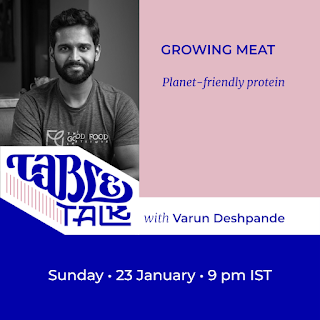
The flyer has a portrait of Varun Deshpande over the logo Table Talk, which flows into their name. The text: Headline: ‘Growing meat’ Subhead: ‘Planet-friendly protein’ Below, ‘Sunday, 23 January, 9 p.m. IST’

Table Talk with Varun Deshpande
Date: 23 January, 2022
Time: 21:00 IST

In India, contrary to some western belief, most of us aren’t vegetarian. True, our per capita consumption of animal protein is nowhere near as much as in some more developed economies, but there are a lot of us, so we wind up eating a fair amount between us. I’m a meat eater too, but not one with an untroubled conscience. I’ve tried over the years to reduce my consumption of meat, eating it maybe once or twice a week, but I like it too much to quit entirely.

So, a few years ago, when I was with The Hindu, I was intrigued when my friend Lynn de Souza forwarded some material to me from the Good Food Institute, which had begun operations in India, and suggested I meet up with them. I did, and I have followed their work since. GFI is an international network of non-profits that works towards sustainable ways of giving us our protein, allying with scientists, foundations, governments, entrepreneurs, and corporations.

Our guest this Sunday is Varun Desphande, MD of GFI Asia. Varun has been deeply immersed in healthcare and technology from a very young age, studied chemical and biomedical engineering at Carnegie Mellon, and has worked on implementing digital health in India and the USA.

We will talk, as we usually do on Table Talk, about formative food memories, and from there we will go on to his journey to GFI and why he chose this work to focus on and more about what GFI does. Along the way, we will learn about the two main streams in this field, lab-gown meat and plant-based meat substitutes, and what the latest developments are. We will chat for a couple of hours, more if Varun and you folks are amenable. And, as ever, there will be plenty of time for audience questions.

Giving back

Table Talk is free to attend, but we ask our guests to name a charity or cause they support, and we ask those attending to make a donation to that cause, Varun has two choices, GFI itself — it is a non-profit, as I said above, and this is their donation page — and Fortify Health Foundation, which works on anaemia and neural tube defects in India, through flour fortification. You can find out how to donate via this page.

Attending

You will need to go to the Zoom link and register with a valid email address, after which you will get the link to join the event.

To get notifications of new episodes and links to past episodes, please subscribe to:
- this Google Group: https://groups.google.com/d/forum/ttandfps
- and / or this Telegram Channel: https://t.me/TTandFPS

(About Table Talk and past guests.)

Tuesday, 18 January 2022

Chances are…

There was a time in advertising, when a lot of ad copy started with ‘Chances are…’

And back when I was a junior trainee dogsbody in Lintas, my reporting boss, Cherian Varghese, reacted to copy we showed him with either ‘Chances are there’ or, more often, ‘Chances are lesssss.’

These things are important for context.

So, one night, we were all up late in Express Towers, finishing off stuff for the weekly meeting at our big client in Pune. Our creative director and the client servicing team would be at VT in the morning to catch the Deccan Queen to go present stuff to the client’s top brass. There was a lot of work, print ads, hoardings, TV scripts, and below-the-line stuff like leaflets.

Cherry kept bouncing our ideas, our headlines, body copy even. We heard ‘Chances are less’ many times that night. At some point, in one of the smaller items, one of us put dummy copy in the layout as a place-holder. Only, instead of the usual Lorem Ipsum, we filled up the available space with ‘Chances are less, chances are less, chances are less,’ and ended with ‘Chances are there.’ We were mighty amused with our wit.

We ordered dinner. The night wore on. We were tired. We took printouts, made mock-ups, packed envelopes with the creative that the junior AE would ferry to the station.

We forgot* to change the dummy text.

The next day, Adi Pocha, our CD, was presenting the creative. When it came to this leaflet, glancing down seeing copy starting with ‘Chances are,’ which, as I said, was a bit commonplace, he didn’t tell client that the layout had placeholder copy which would be worked out later, as he would have normally, and began to read.

The next day at the agency, Adi, to his credit, didn’t chew us out. He just said, ‘You bastards.’

* Or did we?

Saturday, 8 January 2022

Table Talk with Kurush Dalal

The flyer has a portrait of Kurush Dalal over the logo Table Talk, which flows into their name. The text: Headline: ‘Digging in’ Subhead: ‘What lies beneath’ Below, ‘Sunday, 9 January, 9 p.m. IST’

Table Talk with Kurush Dalal
Date: 9 January, 2022
Time: 21:00 IST

Kurush has been our guest before, so I won’t re-introduce him. We will chat this time about the same broad area: the intersections of food, cooking, archaeology, anthropology, culture, and also what he’s been doing since we chatted back in May.

We’ll chat for at least a couple of hours, including questions from and discussion with the audience, and may go on longer, if Kurush and you are willing.

Attending

You will need to go to the Zoom link and register with a valid email address, after which you will get the link to join the event.

To get notifications of new episodes and links to past episodes, please subscribe to:
- this Google Group: https://groups.google.com/d/forum/ttandfps
- and / or this Telegram Channel: https://t.me/TTandFPS

(About Table Talk and past guests.)

Friday, 24 December 2021

Table Talk with Anita Roy, Kishi Arora, Krish Ashok, Kriti Monga, Kurush Dalal, Ranjini Rao, Rushina Munshaw-Ghildiyal, Saba Mahjoor

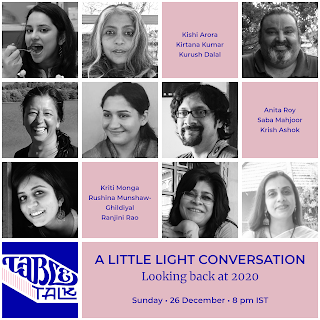
The flyer has portraits of Anita Roy, Kishi Arora, Krish Ashok, Kriti Monga, Kurush Dalal, Ranjini Rao, Rushina Munshaw-Ghildiyal, Saba Mahjoor, the logo Table Talk, and the text: Headline: ‘A little light conversation’ Subhead: ‘Looking back at 2021’ Below, ‘Sunday, 12 December, 8 p.m. IST’

Table Talk with with Anita Roy, Kishi Arora, Krish Ashok, Kriti Monga, Kurush Dalal, Ranjini Rao, Rushina Munshaw-Ghildiyal, Saba Mahjoor
Date: December 26, 2021
Time: 20:00 IST

Table Talk brings the year to an end with an informal chat with as many of our 2020 guests as could make it.

We’ll be looking back at the year and what we have learnt from it, with reference to food, but, as we have found through these past conversations, that can intersect with just about anything.

And of course we look forward to all of you joining us too.

We’ll chat for two to three hours, maybe more if you and our guests are willing.

Attending

You will need to go to the Zoom link and register with a valid email address, after which you will get the link to join the event.

To get notifications of new episodes and links to past episodes, please subscribe to:
- this Google Group: https://groups.google.com/d/forum/ttandfps
- and / or this Telegram Channel: https://t.me/TTandFPS

(About Table Talk and past guests)

Friday, 10 December 2021

Check this

What connects Chennai, Scottish Lace, Brooks Brothers, David Ogilvy, and a pioneering Indian luxury hotel chain?

In the 1950s, CP Krishnan Nair, who had quit the army, helped start the All India Handloom Board. He was also an entrepreneur, one who started multiple companies, many named after his wife. At one point, he sold a shipment of madras fabric (worth a look-up on its own, if you’re not familiar with it) to an American buyer, with the warning that the cloth should only be washed gently in cold water or the fabric would bleed. Someone neglected to tell Brooks Brothers, who had bought a sizeable amount of the cloth, about this. And so the clothes they made from the fabric went out to customers without appropriate washing instructions, and the bright dyes bled, and the colours faded.

The importer summoned Nair to the USA, threatened legal action. Instead they worked out a brilliant compromise and turned this lemon into lemonade.

They arranged an interview with Nair with Seventeen magazine. He made up from whole cloth (hehe) a story about this fabric made exclusively for Brooks Brother, and the mag ran a seven-page piece about “Bleeding Madras — the miracle handwoven fabric from India.”

Ogilvy? He turned the defect into a USP: “Guaranteed to bleed,” the ads said. One catalogue in 1966 carried this copy: “Authentic Indian Madras is completely handwoven from yarns dyed with native vegetable colorings. Home-spun by native weavers, no two plaids are exactly the same. When washed with mild soap in warm water, they are guaranteed to bleed and blend together into distinctively muted and subdued colorings.”

And Scottish Lace? Among the many companies Nair started was a lace-making factory in Sahar, Bombay, named Leela Scottish Lace, which was also the company that sold that fabric which landed up with Brooks Brothers.

And if you were around when the Leela Kempinksi (as it was first called) came up, you may have noticed a sign nearby with the company name. Captain Nair, as he was popularly known, is perhaps best remembered for the hotel chain.

(By the by, there is a town in Oregon, USA, called Madras (population 6,000-odd), and one story is that it was named after madras fabric.)

Bonus: there’s a connection with bermuda shorts.

In the 1930s, the Bermuda Athletic Association would invite Ivy League teams to play their rugby a tournament. This became so popular that there were chartered flights for students, who would bring back clothes they bought there. Among them, plaid- and madras-patterned swimwear and shorts, which then made their way to jackets and suchlike with the preppy New England folks.

Sources Gentleman’s Gazette, Orvis, Madras Musings, Wikipedia article on CP Krishnan Nair

Thursday, 9 December 2021

Table Talk with Manu Chandra

The flyer has a portrait of Manu Chandra over the logo Table Talk, which flows into their name. The text: Headline: ‘Straight toque’ Subhead: ‘Deconstructing the chef’ Below, ‘Sunday, 12 December, 9 p.m. IST’

Table Talk with Manu Chandra
Date: December 12, 2021
Time: 21:00 IST

The various Olive brands, Toast & Tonic, Monkey Bar, The Fatty Bao, Cantan… You’d think I would have first encountered Manu through one of the many innovative, popular and critically acclaimed restaurants he has nurtured and/or created. But when he was making his mark, I was going through a particularly insolvent phase and then rebuilding from there, and fine dining was something that was, as my young friends say, out of my aukat. I first met him when I was editing ForbesLife India, and he wrote for us about the importance of sourcing local ingredients, and since then, his has been one of the voices on food that I’ve listened to carefully. At one point I somehow wound up on the guest list for the opening of The Fatty Bao in Bombay, and had the additional good fortune of having Manu sit with Antoine and I and informally explain some of the thinking behind his ideas.

The making of Chef Chandra started with an early interest in food and what went into making it and presenting it, and continued with formal study (like previous guest Kishi, he trained at the Culinary Institute of America, and their times there overlapped a bit), apprenticing in celebrated kitchens (Restaurant Daniel, Le Bernardin, Gramercy Tavern, Café Centro, Jean Georges), formative jobs (Mandarin Oriental,  Eyvind Hellstrom’s Bagatelle), prizes (a Sea Food Masters Award for the National Recipe Competition in the USA), before he returned to India, where he joined Olive Beach in Bangalore as Chef de Cuisine.

We will chat about this journey and his other formative influences, his work highlighting locally sourced ingredients, what it takes to be a chef, the challenges of running restaurants — multiple restaurants, each with distinct identities — the joys and sorrows of celebrity, The Social Kitchen, an initiative he is part of that wants to “bring families back to the kitchen or table to interact and talk using new kitchen design,” and what he’s been up to since he decided, a few months ago, to leap into the unknown. As ever, be prepared for digressions — these are conversations, not formal interviews — and you’re welcome to nudge us into them or back on topic.

We’ll chat for at least a couple of hours, including questions from and discussion with the audience, and may go on longer, if Manu and you are willing.

Giving back

Table Talk will stay free to attend and free to listen to or watch later, for as long as I can afford to keep it that way. But we would like to use our privilege to help others, so we’re asking our guests to choose a cause.

(I’ll add Manu’s choice here shortly.)

Attending

You will need to go to the Zoom link and register with a valid email address, after which you will get the link to join the event.

To get notifications of new episodes and links to past episodes, please subscribe to:
- this Google Group: https://groups.google.com/d/forum/ttandfps
- and / or this Telegram Channel: https://t.me/TTandFPS

(About Table Talk and past guests.)