Whatever your opinion of the politics or policies of independent India’s first crop of leaders, the ones who had fought for independence, you would have to concede this: against all odds, they brought together an unwieldy mix of peoples and ethnicities, languages and cultures, aspirations and enmities, and made it work.
For there was no India as a country before the Raj, not any more than an Africa or a Europe is a country. Over the millennia, foragers, hunters, warriors, traders, seekers, and refugees, came and melded in. Kings fought each other, as is their wont, territories ebbed and flowed, as did the hold of various religions, with no single one of them ever controlling the entire subcontinent.
And these extraordinary leaders, they realised the wisdom of unifying against a common foe, their occupier, they worked to bring people together, and they dreamt up a nation.
Their only failure — and I do not mean to point a finger at any individual, but to that crop of leaders as a whole — I think, was in ultimately not being able to hold together in that unity the people of what we now know as Pakistan and Bangladesh.
Aldente: Signal to the soloist to just noodle a bit while the rest of the orchestra takes a breather.
Allego: Just put the pieces together.
Alpacino: Chorus: take a deep double exhalation similar to ‘Hoo ha!’
Cappuccino: Play this quickly so we can break for coffee.
Capricioussimo: I’m just changing the entire mood and temp here because I’m the composer and I can, so keep up.
Commando: Without inhibitions. Like you’re not wearing undies.
Con biro: the composer made some hasty corrections to the score here with a ball-point pen.
Egotismma: Extend the solo like there aren’t several dozen other musicians on the stage.
Fortyssimo: Yes, you once dreamt of being the soloist, but here you are, middle-aged, sixth violin with no hope of making even fifth, so just crank it out, dammit.
Glitzando: Make it sound like the theme song of a celebrity reality show.
Louisvuittoni: Sing this note with repressed emotion. Like, emotional baggage.
Mezzanino: This part is designed to please the people in the cheap nosebleed seats.
Namotissimo: Play the same note repeatedly in a grandiose way.
Pizzacato: Violins: play using the fingers like how you steal the pepperoni from someone else’s slice.
This a more-links-added, lightly edited, slightly rearranged version of a Twitter thread I made, which starts here.
My parents Clarice ‘Clarie’ M Griffin (in spectacles) and R. James ‘Jimmy’ Griffin (in the dark suit) at a dance in Vizag in the early 1960s. Probably in the Railway Institute and also probably hosted by the Anglo Indian Association.
There aren’t many AIs (one way the community likes to refer to themselves) left. There were roughly 500,000 at Independence, and since the community hasn’t been counted after the 1941 Census, one can only estimate the current population; guesses range as much as from 150,000 to 400,000. You’ll find AIs concentrated in what were railway junction towns, the former Presidencies, and hill stations. having felt never British enough for the British and never Indian enough for Indians, many AIs migrated to Commonwealth countries in the years after 1947 — over a 100,000 immediately after Independence — and today, the diaspora — mainly in Canada, Australia, New Zealand, USA — is estimated to be around 500,000.
(In my family, my father’s father served in the British army, but felt too rooted in India to migrate. Two of his daughters, my aunts, migrated to Canada (and from there to the USA) and Australia. My father’s mother’s family was Burma-based, or at least her brothers were. My mother’s father was a senior official in the Indian Railways, but he died young, before Independence, leaving my grandmother too poor to consider migration. One uncle continued the family tradition, spending his life working in the railways, but none of that generation migrated, though most of mother’s second cousins moved to either the UK or Australia. Most of my parents’ friends from their youth eventually migrated. My parents did try to move — not because of lack of roots in India, my dad told me, but to ensure better medical care for my brother — but that fell through for complicated reasons.)
The community organises a world reunion every three years, moving between diaspora countries and India. It was at one such event — in New Zealand in 2001, according to this page — where it was decided on 2 August as a day of celebrating Anglo-Indian culture, which became World Anglo Indian Day. Why that date? I haven’t a clue.
What is an Anglo-Indian?
In the 1800s, the term described British people working in India. Another sense of the term was for British residents of British ancestry who had been born in India (this usage too is outdated). The Indian census of 1911 defined the term to mean persons of mixed British and Indian ethnicity — people who had before that era been referred to as Eurasians — and this has come to be the prevailing definition. The Government of India Act of 1935 defined an Anglo-Indian in the patriarchal way of its times as “a person whose father or any of whose other male progenitors in the male line is or was of European descent but who is a native of India.” This definition persisted, more or less, in the Constitution of India, including the bit about the paternal line — it too being a creature of its times — which defines Anglo-Indian thus:
[An] Anglo Indian means a person whose father or any of whose other male progenitors in the male line is or was of European descent but who is domiciled within the territory of India and is or was born within such territory of parents habitually resident therein and not established there for temporary purposes only.
In practice, other communities of part-European descent who had or have a presence in India — Goans with Portuguese ancestry, Armenians, folks with French or Dutch ancestry — mostly do not call themselves Anglo-Indian. Remember also that the colonial powers were fighting one another until the Brits prevailed, so perhaps their descendants would not like to be mixed up with each other. (I am told, though — and knew some folks, friends of the family — that in parts of the country further from Portuguese, Dutch or French colonies, some folks of those ancestries do identify as AI.)
AIs are defined in the Constitution because of reserved seats for the community in the Lok Sabha …
Article 331 of the Constitution of India “Representation of the Anglo-Indian community in the House of the People.”
Notwithstanding anything in Article 81, the President may, if he is of opinion that the Anglo-Indian community is not adequately represented in the House of the people, nominate not more than two members of that community to the House of the People.
… and in some state legislatures (Article 333) (similar to reservations for Scheduled Castes and Scheduled Tribes in some states (Article 332)) …
Article 333
Representation of the Anglo Indian community in the Legislative Assemblies of the States
Notwithstanding anything in Article 170, the Governor of a State may, if he is of opinion that the Anglo Indian community needs representation in the Legislative Assembly of the State and is not adequately represented therein, nominate one member of that community to the Assembly.
Why were these provisions made?
Frank Anthony, lawyer, educationist, community leader, and member of the Constituent Assembly, made the case that since AIs did not have a state, and were too small and geographically spread out to get a community member elected to represent community interests in parliament or state assemblies, AIs needed reserved seats. (Anthony himself was one of the nominated members in the Lok Sabha eight times, five times as an independent, and thrice as part of the Indian National Congress.) This was supposed to be for ten years, but like the similar reservations for SC and ST seats, has been routinely extended. (Until 2019, when the 104th Amendment to the Constitution effectively ended this reservation, while extending the reservations for SCs and STs. Apparently the law minister said that the reservations were no longer needed because as per the 2011 Census, there were only a few hundred AIs left in the country. I do not know about the Census data, but that number is definitelty not accurate. There go my chances of ever being an MP or an MLA.) These seats were in the gift of the government in power, so nominees tended to be supporters of that government. The only times this made the news is when there were floor test with tiny margins. I wrote about this the last time it happened.
Incidentally, Derek O’Brien is the first-ever Anglo-Indian MP not to be nominated under these constitutional provisions. So, for the first time, there are three AI MPs. George Baker and Richard Hay, both BJP members, nominated to the Lok Sabha, and O’Brien in the Rajya Sabha.
(Lots of folks know that O’Brien was, among other things, a quiz host on television, but many younger people may not know that he has a quizzing legacy: his father, Neil O’Brien, was a legendary quizmaster, besides, among other things, also an MP, in one of the nominated seats in the Lok Sabha.)
But, back to the community at large. Though ‘large’ may not be the correct term, since there are so few of us left. : )
You’ll find a lot of AIs still in railway towns, because that was one of the occupations that the Brits preferred to have them in. (I’m told that AIs had job reservations in the Indian Railways until the 1960s, but I have only anecdotal evidence and no source to cite.) You’ll also find clusters in hill towns, many of them descendants of Brits who liked India too much to leave post-1947. Like Ruskin Bond’s and I Allan Sealy’s families.
Oh yes, there was one attempt to create a sort of Anglo-Indian mini state, a homeland; a town, more accurately. McCluskieganj. Among others, writer and former Granta editor Ian Jack wrote about in his book Mofussil Junction (an extract here), Shamik Bag wrote a piece in Mint. Filmmaker Paul Harris also made a documentary and photo book about McCluskieganj, Dreams of a Homeland.
Several film stars are/were AI: from Helen and Cuckoo in yesteryears to more recently, Diana Hayden and my pal Denzil Smith. Stand-up comic and actor Russell Peters is a member of the AI diaspora. Writer friend Madhulike Liddle reminded me, “Incidentally, Hindi cinema owes a lot (though it invariably goes unacknowledged) to AIs. An overwhelming number of dancers — all those 'club dancers' in 50s-60s films — were AI. People like Edwina and her brother Terence Lyons; Herman Benjamin; Oscar; Teresa; Abe Cohen.” (Benjamin and Cohen were Jewish, though.) And there were lots of Anglo Indian musicians, particularly in the big cities, and most notably in Calcutta.
On the global scene, some celebrities: Cliff Richard, Engelbert Humperdinck, Vivien Leigh, Merle Oberon, though I think they all either denied this or did not identify as Anglo Indians. I think they’d fall under the now mainly historical usage of the term, people of British ethnicity born in India. Authors Gerald Durrell and Laurence Durrell would also fit this definition.
There were also significant contributions from the community to the armed forces. One I remember straight off is Admiral Stanley Dawson, Chief of Naval Staff, who was a family friend. (One of my aunts, who never married, would joke about Stanley being her boyfriend. Dawson never married either.) And Air Chief Marshal Denis La Fontaine, who served as Chief of Air Staff of the Indian Air Force.
And, in sports, Indian hockey had quite a few AIs. (Many diaspora AIs contributed to Australian hockey.) Roger Binny played cricket for India, was part of the team that won India’s first world cup, and his son Stuart also played for India. And Wilson Jones, a world billiards champion, India’s first, before Michael Fereira. And, if I’m not mistaken, Jennifer (Dutton) Paes, who captained India in basketball and played in the Olympics, and is Leander Paes’s mother, is AI too (Vecce Paes, his dad, was born in Goa before India took over, if I recall right).
In less prominent walks of life, the native English speaker advantage meant that a lot of AI women became teachers (like my mother, and her mother, and the mothers of several of my friends, and as replies to my original Twitter thread told me, people all over the country have fond memories of AI teachers) and secretaries, and a fair number found work as nurses. Anglo-Indians played a significant role in education, running a number of schools. And if you happen to be proud of passing your ICSC and/or ISC exams, Frank Anthony played a role there: he was the founding chair of the Council for the Indian School Certificate Examinations, which operates the ICSE board of Education.
For a sensitive chroncile of ordinary AI lives, see the fabulous photo book by Dileep Prakash, The Anglo-Indians; there’s a web site and his blog with more info, and the book is available on Amazon.
There used to be a forum, back in the day called Pepperwater. The site does not seem to be active now, but here are some archived versions. (Pepper-water — a cousin of rasam, I would say — is another quintessentially AI dish.)
Special mention of one person who has done a lot to document and preserve Anglo-Indian cuisine: Bridget White Kumar, in her books, and on her site and blog, where I go frequently, because I didn’t learn from my mum when I could have.
A film by Paul Harris (the fim-maker mentioned above, in connection with McCluskieganj) on AI cuisine:
Also by Paul Harris, Anglo-Indian-isms:
And this Sahapedia film by Basav Biradar on Kolar Gold Fields, an AI stronghold:
The All India Anglo-Indian Association has a web site, but it yields an ‘under construction’ message as of this writing. There is a Facebook page, though. There are a few AI groups on that platform too, but I won’t link to them because they are infested with dad jokes and sexist jokes.
A slide show from The Anglo-Indian Archives
Pepper Watcher, a YouTube channel by the magazine Anglos In The Wind.
…
The very popular vlogger Dhruv Rathee has a video about the community, with some minor inaccuracies (as far as I know). He speaks in Hindi, but there are English subtitles and a YT-generated autodub in English available in the settings.
p.s. There were, of course, Anglo Indians in the parts of undivided India which became Pakistan and Bangladesh. I know very little about them, except that the community has almost vanished in Pakistan, but has stayed somewhat stable in Bangladesh. (I learnt recently that there are almost 200,000 AIs in Bangladesh. That’s higher than the lower-end estimate for India.) In Sri Lanka, where there was stronger Portuguese and Dutch influence in addition to British, people with part-European ancestry who have retained European customs are called Burghers. There were also AIs in Burma (my father’s mother’s family was from there, for instance, and my father’s father, who was in the British Army, was posted there until World War II and the Japanese incursion) and many intermarried with the Anglo-Burmese community, but that population also mostly left the country when it first went under military rule.
p.p.p.s. This piece by Mitali Parekh in Mid-Day about reactions from AIs to the end of reservations for the community, in which I am quoted and which used a picture of my parents and their friends.
Last night, I went for a walk pretty late; it was midnight when I started out.
The roads were almost deserted, as is natural in a residential neighbourhood which is also a dead-end (in the sense that no one needs to pass through it on the way to somewhere else). A couple of people walking dogs, the occasional autorickshaw ferrying some poor sod home from a late night at work, the odd food-app delivery person whizzing by on a motorbike, small groups standing around cars in a stretch where there are two restaurants and a bar. A few more folks further from home, in a designated walking/skating/cycling area, but just a scattering.
And I saw three women who I see often at night; I first noticed them because of the way they dress: one is always in one of those kaftan-style nightgowns, one usually wears saris but now and then a salwar kameez, and one is always in the tight-jeans-and-T-shirt ensemble that is common among younger people today. I’ve never looked closely at them for decorum reasons, but I get the impression they’re in their thirties. They walk side by side, taking up space on the road so that I have to walk around them when I pass them, and the stray words that drift to me as I do are in Marathi.
Further along, at a brightly-lit I-❤️-Navi-Mumbai selfie point, two young women, mid-twenties, perhaps, had parked a scooter and were taking pictures. Not of themselves with the sign in the background, but using the raised letters to stand their phone on, while they made — I’m assuming — Instagram Reels. I’m assuming this because there was much hair swishing and hand gesturing and general hamming. These women looked to be from the north-east, and they were in short shorts and T-shirts. They were talking loud and laughing loud and generally having a good time.
On the way back, on a stretch of road which had a few non-functioning streetlights and so was a bit dark, three girls, who seemed to be of college age, were hanging around a bus-stop. One was standing next to the raised road divider making a dramatic hands-reaching-out gesture, a second, facing her, at the bus-stop, mirrored the first, and the third had her phone raised to record them and was calling out instructions. Two wore jeans and T-shirts, the third wore a T and a track suit bottom, or maybe they were pajamas. They stopped their shoot, waiting for a couple of vehicles to pass between them, and were about to resume, when they saw me approaching, and they paused again waiting for me to pass.
I wanted to smile at all three sets of women, because it made me happy to live in a neighbourhood where women feel safe enough to be out at night with no purpose other than to be out at night, dressed however they like. What Sameera and her co-authors call loitering, what Jasmeen and the Blank Noise movement call unapologetic walking, with the second and third sets, what I like to think of as as innocent shenanigans.
Of course I didn’t, partly because I mask when I go out for a walk, but also because while it is a nice place to live in, I can imagine that having a scruffy half-bald-half-long-haired man grinning at them as he lumbered past would not contribute to their feeling of safety.
And so, instead, I’m smiling when I tell you this story.
Welcome to a little crowd-sourced project, mapping and listing indie bookstores in India. There are 131 of them so far. (Last edit: 7th October, 2023.)
This was prompted by an online exchange with Leonard Fernandes, co-founder of The Dogears Bookshop — who also did a disproportionate amount of the heavy lifting — and put together by me. Both map and list are embedded below, but you can also see them indpendently, on Google maps at https://bit.ly/bookstores-in-india, and on Google sheets here.
How you can help
Go through the map and/or the list and check if I missed bookshops you know and and give me their names and addresses and web sites, if available, or even better, a Google Maps link or latitude-longitude or even an Open Location Code (OLC). As you will see, vast swathes of the country are missing. (As of this edit, all of Arunachal Pradesh, Bihar, Chhattishgarh, Dadra and Nagar Haveli and Daman & Diu, Jammu & Kashmir, Jharkhand, Ladakh, Lakshadweep, Nagaland, Punjab (not counting Chandigarh), Tripura, and pretty much all of non-metropolitan India.) And, since my social media circles are more likely to include folks who read in English, there are probably lots of shops selling books in other Indian languages that I missed. Also, if I’ve included shops that you know are not primarily booksellers (see below), let me know. (If you’d prefer not to comment here, you can find my social media links here on the sidebar. Specific posts: Twitter, Instagram, Facebook, Mastodon) If you know the people who own these stores, or happen to visit them, ask them if they know about this map, and if they don’t, show it to them. : )
What the map and list include
Brick-and-mortar shops which are solely or mostly sellers of trade books. (Simplistically, not textbooks or academic publications. Though, of course, books you and I buy for leisure reading can find themselves included in syllabi and all books educate us.)
What they do not include:
• Shops that primarily sell stationery, or textbooks or educational books.
• Shops that sell books that promote only one religion, or one organisation, or one political party.
• Shops owned by a publisher or distributor which only, or primarily, sell books by that publisher or distributor.
• Shops which are part of large chains (more than two shops in more than two cities, to draw an arbitrary line). Nothing against these — I’ve done a fair amount of book-buying from them — but this is to support the indies.
If the shop also runs within the same premises an unrelated for-profit business — say a café — then we’ll only include them if their primary gig is book-selling.
For the record, I do not own, run, or have a financial stake in any bookshop — though I do know several owners personally — and no one has paid to be included in this map and list.
Support your local small and indie bookshops!
You can mess around with this embedded map here, zooming in and out and clicking on the icons and all that, but you can also choose to see it on Google Maps, where you can do things like get directions.
This list is sorted by state, city, locality, name (with the ‘the’ parts moved to the end, for example, ‘The Bookshop’ becomes ‘Bookshop, The’), and, where possible, with links to web sites. You can also see this spreadsheet here, where you can choose to sort by any of the headers.
Caferati Listings carries opportunities for writers — calls for entries and submissions to contests and anthologies, assignments, jobs — since October 2006 (but with a gap between 2012 and 2019) via email on Googlegroups and since April 2021 a Telegram channel (update: and since September 2023, an experiment with a Whatsapp Channel). You subscribe to the Telegram and WhatsApp channels via a cellphone number, but you can also see them on a desktop browser and desktop apps. All versions of these Listings are absolutely free for subscribers. Anyone can send a tip-off or a submission; there’s a form embedded at the end of this post.
More
The Google Groups emails are collections, compiled whenever I have the time to put together an edition. The Telegram and WhatsApp channels send out individual opportunities as and when I see them. Email and channel updates are not identical: sometimes, something I’ve posted to Telegram may have a deadline expiring before I send the next email compilation; mostly, though, everything in the email will have appeared in or will appear in the channels, unless I forget. One difference between Telegram and WhatsApp is that posts to WA subscribers will disappear after 30 days.
Important: all are one-way; that is, I can post in the group, but you, or anyone else, cannot. So the only chatter you will hear is from me. If you’re worried about clutter, the email never goes out more than once a week; the Telegram and WhatsApp channels may sometimes see a bunch of updates. Usually, the email has fewer typos. The Google Groups and Telegram channel archives are available online, but WhatsApp retains only the last few months before they vanish.
A note on privacy.
When you subscribe via Google Groups, no one else can see your email address except admins.
With the Telegram channel, no one else can see your details, except the admins, they can only see your phone number if they already have you in their personal Telegram contacts and/or if your own privacy settings permit it. (Telegram privacy is very granular, and you should see your settings before subscribing to any channels, joining groups, or even adding anyone you don’t know to your contacts there.)
On WhatsApp, no one else can see your details. Even the admins can’t see folk that are not already in their contacts. (More about WA channels.)
In all these, I will only contact you through them to send you Listings and, very rarely, a promotional note for other Caferati stuff or other writing-related things I am personally involved with, which might appear as a note within a Listings email or as a separate Telegram or WhstsApp post. I will never contact you individually unless we already correspond and have each other’s contacts. I do not give anyone else access to your contacts, and never will.
A note to people who have opportunities to share.
The email newsgroup has over 1750 subscribers; the Telegram channel, set up more recently, has around 250 (these are as of September 2023, when the WhatsApp version has just been added). Every single one of them has opted in to receive Listings. And they are there because they want to see these opportunities. So, if you or your organisation have a requirement, or if you come across opportunities and want to share them with the community, please do get in touch. If you know me personally, email me with ‘for Caferati Listings’ in the subject line, but preferably, please use this Google form for submissions or tip-offs (the form is also embedded below), because it helps me keep organised.
I don’t charge to carry a Listing. But what goes into the Listings is my call. As a general guideline, I don’t include anything that requires a non-trivial entry or submission fee and work that doesn’t offer pay. I may sometimes include zines and things like that that do not pay which I think are interesting.
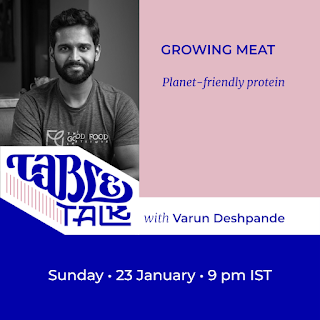
Table Talk with Varun Deshpande
Date: 23 January, 2022
Time: 21:00 IST
In India, contrary to some western belief, most of us aren’t vegetarian. True, our per capita consumption of animal protein is nowhere near as much as in some more developed economies, but there are a lot of us, so we wind up eating a fair amount between us. I’m a meat eater too, but not one with an untroubled conscience. I’ve tried over the years to reduce my consumption of meat, eating it maybe once or twice a week, but I like it too much to quit entirely.
So, a few years ago, when I was with The Hindu, I was intrigued when my friend Lynn de Souza forwarded some material to me from the Good Food Institute, which had begun operations in India, and suggested I meet up with them. I did, and I have followed their work since. GFI is an international network of non-profits that works towards sustainable ways of giving us our protein, allying with scientists, foundations, governments, entrepreneurs, and corporations.
Our guest this Sunday is Varun Desphande, MD of GFI Asia. Varun has been deeply immersed in healthcare and technology from a very young age, studied chemical and biomedical engineering at Carnegie Mellon, and has worked on implementing digital health in India and the USA.
We will talk, as we usually do on Table Talk, about formative food memories, and from there we will go on to his journey to GFI and why he chose this work to focus on and more about what GFI does. Along the way, we will learn about the two main streams in this field, lab-gown meat and plant-based meat substitutes, and what the latest developments are. We will chat for a couple of hours, more if Varun and you folks are amenable. And, as ever, there will be plenty of time for audience questions.
Giving back
Table Talk is free to attend, but we ask our guests to name a charity or cause they support, and we ask those attending to make a donation to that cause, Varun has two choices, GFI itself — it is a non-profit, as I said above, and this is their donation page — and Fortify Health Foundation, which works on anaemia and neural tube defects in India, through flour fortification. You can find out how to donate via this page.
There was a time in advertising, when a lot of ad copy started with ‘Chances are…’
And back when I was a junior trainee dogsbody in Lintas, my reporting boss, Cherian Varghese, reacted to copy we showed him with either ‘Chances are there’ or, more often, ‘Chances are lesssss.’
These things are important for context.
So, one night, we were all up late in Express Towers, finishing off stuff for the weekly meeting at our big client in Pune. Our creative director and the client servicing team would be at VT in the morning to catch the Deccan Queen to go present stuff to the client’s top brass.
There was a lot of work, print ads, hoardings, TV scripts, and below-the-line stuff like leaflets.
Cherry kept bouncing our ideas, our headlines, body copy even. We heard ‘Chances are less’ many times that night. At some point, in one of the smaller items, one of us put dummy copy in the layout as a place-holder. Only, instead of the usual Lorem Ipsum, we filled up the available space with ‘Chances are less, chances are less, chances are less,’ and ended with ‘Chances are there.’ We were mighty amused with our wit.
We ordered dinner. The night wore on. We were tired. We took printouts, made mock-ups, packed envelopes with the creative that the junior AE would ferry to the station.
We forgot* to change the dummy text.
The next day, Adi Pocha, our CD, was presenting the creative. When it came to this leaflet, glancing down seeing copy starting with ‘Chances are,’ which, as I said, was a bit commonplace, he didn’t tell client that the layout had placeholder copy which would be worked out later, as he would have normally, and began to read.
The next day at the agency, Adi, to his credit, didn’t chew us out. He just said, ‘You bastards.’